

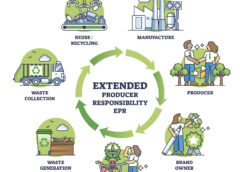
The issue of extended producer responsibility is a growing concern for commercial mail producers, so our legal advisors from Brann & Issacson have offered our subscribers some guidance on the matter.
California’s Packaging Extended Producer Responsibility Program: Why Commercial Printers and Mailers Are
Officially in the Conversation
For years, environmental compliance lived comfortably upstream – brand owners worried about it, packaging manufacturers designed around it, and commercial printers and mailers mostly executed.
Not any longer. If your business touches printed packaging, inserts, labels, catalogs, mailers, or fulfillment, California’s Extended Producer Responsibility program is no longer a “watching brief.” It’s a fast-developing compliance system that will change who pays, who reports, and how packaging is designed and sourced – with ripple effects through print and mailing workflows. California’s Extended Producer Responsibility (EPR) program changes that dynamic.
While the program is still framed legally around “producers,” recent developments from CalRecycle make one thing clear: printers and mailers are now operationally essential to compliance. The rules are still being finalized, but the direction of travel is unmistakable – and the data, design, and documentation burden is already moving downstream. Commercial printers and mailers may indeed qualify as producers, and even now sit uncomfortably close to the regulatory blast radius
This article focuses on what’s new in California1 since our last EPR article in late 2024, what California’s program really means for commercial printing and mailing operations, and what steps make sense now.
A fast refresher: California’s EPR Program in one page (no policy seminar required)
California’s Plastic Pollution Prevention and Packaging Producer Responsibility Act (SB 54), enacted in 2022, establishes the largest packaging EPR program in the US. The law seeks to shift responsibility for the cost of managing packaging waste from municipalities to “producers,” broadly defined. In doing so, it sets aggressive statewide targets to be achieved by 2032:
- 100% of single‑use packaging must be recyclable or compostable
- 65% of single‑use plastic packaging must be recycled
- 25% source reduction in single‑use plastic packaging compared to a baseline year
To fund this system, California anticipates producers collectively will pay $5 billion over 10 years, beginning in 2027. California’s efforts to implement the program have accelerated sharply since late 2024, with CalRecycle publishing material definitions, reporting guidance, recycling‑rate determinations, and – most recently – reopening regulatory text for public comment in early 2026.
California’s small producer exception protects producers whose California gross sales fall below $1 million (the thresholds in other states vary, though California is the only state to measure its small producer threshold by California-source sales). But exemptions are not a strategy, especially for suppliers serving national brands whose California gross sales clearly exceed that threshold.
Breaking news: regulations are still actively being revised – but the end goals are not
As of January 29, 2026, CalRecycle opened a new 15‑day public comment period on its SB 54 “plastic and packaging reforms,” closing February 13, 2026. This follows multiple rounds of revised draft regulations and reflects ongoing disagreement over scope, exemptions, and compliance mechanics. What matters for commercial printers and mailers is not the regulatory back‑and‑forth – it’s CalRecycle’s consistent message that statutory deadlines and 2032 targets remain unchanged, and industry should prepare to comply even while rules are still being refined.
“Covered material”: why EPR Programs reach commercial mailers
SB 54 applies to “covered material,” defined as single‑use packaging and single‑use plastic food service ware. CalRecycle, the agency charged with administering California’s program, has been publishing and updating a Covered Material Categories List (CMC List) that classifies materials by type and form, including components.
For commercial printers and mailers, covered material can include:
- polywrap and overwrap on magazines and catalogs,
- padded and poly mailers,
- envelopes with plastic windows,
- coatings, laminations, and films applied to printed pieces,
- multi‑material inserts or affixed components included in mailings.
Critically, CalRecycle’s framework evaluates detachable components separately, meaning the plastic window on an envelope or the polywrap around a catalog can be analyzed independently from the paper content. It has also published the first‑ever recycling rate determination for each covered material category. And by publishing recycling rate determinations by material category, California’s EPR program shifts the conversation from:
“Is it technically recyclable?”
to: “Does it actually get recycled at scale in California?”
Why you should care: recycling rate determinations become the backbone for eco-modulation (higher costs for harder-to-recycle packaging), design changes, and – ultimately – what your customers will demand from you in substrates, constructions, and component choices. For commercial printers and mailers, that matters because:
- materials with low recycling rates are likely to face higher EPR fees (eco‑modulation); and
- mail formats historically treated as neutral (polywrap, padded mailers, laminated pieces) are now squarely in focus.
In a print/mail workflow, that translates into tangible changes:
- Artwork/design: fewer mixed-material constructions; more scrutiny of coatings, adhesives, laminations, windows, metallic inks/foils, and multi-layer films.
- Procurement: suppliers asked for substantiation and specs suitable for reporting, not just “it meets our quality standard.”
- Product Selection: Brand owners will pressure suppliers to move away from formats that are recyclable “in theory” but not “in practice
Job costing: producers may seek to push EPR fees (or eco-modulated fees) down into vendor negotiations.
Why printers and mailers keep showing up in “producer” conversations
EPR programs top goal is to go after the top dogs in the production chain. This is why such programs define “producer” starting with the brand or trademark owner. They can cascade, however, to others if that party is not identifiable – potentially reaching importers, manufacturers, or sellers. Some entities that sell into California can end up treated as “producers” in certain circumstances – especially where the brand/manufacturer/importer chain is unclear.
This matters for mailers because even if mailers and commercial printers are not producers, your customers will treat you as a critical data holder for their producer reporting obligations. In other words, your customers as producers need your data – urgently. CalRecycle published producer reporting guidance in September 2025, including category‑based and source‑reduction reporting frameworks. Producers must report type and weight of covered materials placed into California.
For many mail formats, that data lives with printers and mailers, not brand owners:
- material weights by component,
- coatings and laminations,
- exact construction of envelopes, wraps, and inserts.
If you can’t supply it, your customer still has to report – meaning they will push harder, redesign faster, or replace vendors with those that can supply the data they need for compliance. In cases involving imported products or unclear brand ownership, downstream sellers can be treated as producers. This risk is real enough that sophisticated customers are now auditing their supply chains more aggressively. Even when you’re not the producer, you are part of the compliance infrastructure.
Enforcement is real – even if lawsuits aren’t
California’s EPR program does not create a private right of action, meaning no class‑action cottage industry, thankfully. Enforcement authority sits with the state, and civil penalties can reach up to a staggering $50,000 per day for violations.
More importantly for printers and mailers, several EPR states – including California – allow regulators to restrict distribution of non‑compliant products. While current restrictions target single-use food packaging waste, it’s only a matter of time before states turn their attention to other industries.
What smart commercial printers and mailers are doing now
Without waiting for final regulations, leading operators should take pragmatic steps that reduce risk and increase customer stickiness:
1. Building component‑level material libraries
Track substrates, coatings, films, and wraps by material category and weight, not just by SKU or job.
2. Preparing for EPR‑driven redesign requests
Expect more customer questions like:
- “Can we eliminate the polywrap?”
- “Is there a window‑free envelope option?”
- “Can we change the coating and still hit postal requirements?”
3. Updating contracts and scopes of work
Clarify who supplies material composition data, how substitutions are handled, and how compliance‑driven changes affect pricing and timelines.
4. Treating California specs as national specs
California was not the first state to adopt EPR programs, but it is the first to go into effect. What that means is that California’s approach to enforcement will drive national packaging behavior. To get ahead of California, printers and mailers may want to standardize mail formats nationwide rather than manage dual inventories. Planning for California compliance now avoids later rework.
For commercial printers and mailers, there is a strategic opportunity to become the partner who understands EPR programs well enough to keep customers compliant without blowing up their mail programs. Those who treat this as someone else’s problem will still feel it – just later, faster, and on worse terms.
This article was produced exclusively for Mailers Hub by Jamie Szal of Brann & Isaacson.
Brann & Isaacson is a boutique law firm that represents large and small online and multichannel companies, printers, commercial mail producers, and IT service providers located across the country. The firm advises companies of all sizes, including many in the Internet Retailer’s Top 500 Guide.
Brann & Isaacson is Mailers Hub’s recommended legal counsel for commercial mail producers on legal issues, including tax, privacy, consumer protection, intellectual property, vendor contracts, and employment matters.